
Money at a glance
| How you earn | Serving dishes and set menus to customers |
|---|---|
| What drives growth | Menus, decor and fulfilled customer requests |
| What you spend on | Improving the restaurant |
| Fastest method | Not verified |
| Dish prices and profit rates | Not published |
The confirmed earning loop
UnGeek played a short demo and described the basic economy. You develop dishes and set menus, serve them to diners and use the earnings to improve the restaurant. Those improvements then help attract more customers.
Bandai Namco's launch announcement describes the same growth story from the other side. Collecting ingredients, cooking creative dishes and designing a welcoming space turn a modest ship into a renowned restaurant. Toei Animation adds that growing your reputation makes the restaurant the talk of the seas.
Put together, money comes from customers, and customers come from good food, a good atmosphere and fulfilled requests. That is the only earning model the sources support. Everything beyond it would be speculation before launch.
Menus are your product
Your dishes are what customers pay for, so the kitchen is the start of every sale. You mix and match ingredients and recipes with Sanji, then plate and decorate each dish. Finished dishes can be combined with decorative elements into original set menus.
An official Steam screenshot shows a set menu built from a main dish, a side dish, a dessert and a drink. The same screen shows a Tastiness rating for the set. No source explains how that rating affects price or customer spending, so treat it as information on screen rather than a known formula.
Returning customers matter
Bandai Namco says each character has their own preferences for food and decor. By fulfilling customer requests you grow your fanbase and encourage them to return again and again. Regular visitors are the clearest confirmed route to steady business.
The launch announcement also says each restaurant setup can attract different characters and turn visitors into loyal regulars. More than 400 characters can appear as customers. Learning what your regulars like is therefore part of earning, not a separate side activity.
Preferences cover decor as well as food, so a request might ask for a change in the dining room rather than a new dish. Toei Animation says every visit brings new interactions and surprises. Keeping customers happy is the confirmed way to keep them coming back, which keeps sales flowing.
Ingredients feed the menu
New dishes depend on ingredients. The official gameplay guide describes heading out in search of ingredients for new dishes, and the launch announcement says new recipes and opportunities are discovered across the seas as the restaurant grows. A wider menu gives you more to offer the customers who visit.
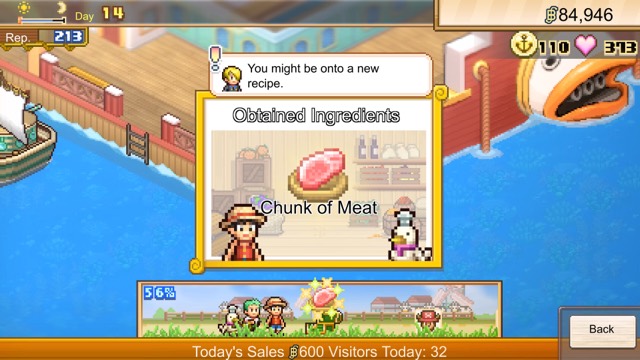
An official Steam screenshot shows an Obtained Ingredients screen with a Chunk of Meat and a note that you might be onto a new recipe. That suggests gathering and recipe discovery are linked, but the exact rules are not published. Our ingredient locations and recipe unlocks pages track what is confirmed about each.
Staff, service and characters
Characters do more than eat. Bandai Namco says they can interact, work and dine in the restaurant, and Toei Animation describes them as both staff and guests. Who works in your restaurant is part of how it runs.
The gameplay guide also mentions Luffy and the Straw Hat Crew training to improve their service. No source gives a number for how training changes sales. Watch your daily sales and visitor counters after training to see the effect for yourself.
Decor and expansion
Spending on the restaurant is how earnings turn into growth. More than 200 furniture and decorative items are available, and different furniture creates different moods around tables. An official screenshot describes one Alabasta Kingdom style lamp as a facility that makes the table more comfortable.
As the restaurant expands, you can explore more of the seas and welcome more customers. Customers can even open their own special shops inside your restaurant. The publisher has not said whether those shops add income, so we do not count them as a money source.
Track your own numbers
Official screenshots show counters for today's sales and today's visitors, plus a day counter and a Rep. value. These on-screen numbers are the best way to judge your own changes. Compare days with similar menus and staff before deciding whether a change helped.
Revenue is not the same as profit. The sources do not publish sale prices, staff costs or upgrade costs, so net profit cannot be calculated from them. A high sales day may still leave less money if you spent heavily on upgrades.
Keep simple notes as you play: the date, what changed and the sales and visitor totals that followed. Over a few days, patterns become easier to see than in any single shift. This is slower than following a promised shortcut, but it produces results you can trust.
What has not been verified
Our research found no cross-checked dish prices, profit rates, top-earning dish or upgrade payback time. We also found no confirmed offline earnings, unlimited money method or exploit. Any guide that promises these before launch is not supported by the evidence we found.
Even the name of the in-game currency has not been confirmed in the written sources. Screenshots show a currency symbol, but we will not guess its name. This page will be updated with measured results after release.
Money myths to ignore before launch
Several kinds of money advice appear around new management games before anyone has played the final version. None of the following had evidence behind it when we checked. Treat any page that promises them with caution.
- A single dish that earns the most money in every situation.
- An exact amount of money per minute or per in-game day.
- Offline or idle earnings while the game is closed.
- An unlimited money trick or exploit.
- A guaranteed best layout for profit.
How a fair money comparison will work
When we test money methods, each comparison will use the same game version, platform, menu and staff. We will record sales and visitors over the same number of in-game days. Only then can one approach be called faster than another.
Results will be published with screenshots and the conditions we used. If a method only works on one platform or version, we will say so. Until then, follow the confirmed loop and focus on happy, returning customers.
Sources and further reading
- UnGeek — hands-on demo impressions (Sep 17, 2026)
- Bandai Namco Europe — launch announcement (Jun 9, 2026)
- Bandai Namco Europe — Gameplay Guide: A Day at Baratie Number Two (Sep 15, 2026)
- Toei Animation — official announcement (Jul 3, 2026)
- Steam — ONE PIECE: Grand Gourmet (app 3905010)